
Agent API: One Place to Build with LLMs, the Web, and Agents

Perplexity is building the infrastructure for work that depends on language models, the public web, and agents running against both. The Agent API is how developers plug into that infrastructure. It’s a single programmable endpoint for web search, URL fetching, code execution, MCP connections, and finance and people search. For each request, these capabilities are composed on demand into a retrieval pipeline.
Today we’re upgrading all Sonar customers to an Agent API preset that scores higher on benchmarks at lower cost. Sonar will remain available for 45 days before the Agent API becomes the single surface for this work. Customers with existing contractual commitments to Sonar are covered through the end of their current term.
Teams use it to build research agents, in-product answer experiences, and workflow automations that need current, cited information, without stitching together a separate search provider, model host, tool runtime, and orchestration layer.
One programmable surface
Before the Agent API, Sonar exposed capability through a fixed set of models: Sonar, Sonar Pro, Sonar Reasoning Pro, and Sonar Deep Research. Choosing a model meant choosing a static bundle of reasoning depth, search behavior, and cost, and locking that bundle into production code. Each tier was a separate product decision rather than a configuration of a shared stack.
The Agent API collapses those tiers into one programmable surface. Six presets, fast, low, medium, high, xhigh, and wide-research, sit on the same infrastructure and expose it at different points on the quality and cost curve. Each preset is a transparent, pre-configured setup: a model paired with a system prompt, tool configuration, reasoning effort, and token budgets tuned against real workloads.
Presets are re-tuned with every frontier model release, so a call to low today and the same call six months from now both reflect the current state of the art at a predictable cost. Every parameter remains overridable.
Sonar tiers map directly to presets: sonar to fast, sonar-pro to low, sonar-reasoning-pro to medium, and sonar-deep-research to high. The xhigh preset extends past Deep Research for open-ended agentic work.
Search as Code, the layer underneath
The Agent API includes web search, URL fetching, a code sandbox, MCP server connections, finance search, and people search. Presets configure these tools by default, and every tool is available to any custom agent configuration.
These tools sit on top of Search as Code, the architecture behind Perplexity’s search stack. Instead of routing retrieval through a single fixed interface, Search as Code exposes search primitives that a model composes on demand into a retrieval pipeline for each request. That is what lets the top-end presets run thousands of retrieval steps in a single call.
It’s also what lets presets across the range deliver better answers per dollar than a traditional search-plus-model pipeline. Developers get the same primitives Perplexity’s own products are built on, in the same API.
Higher quality per dollar across benchmarks
We evaluated Agent API presets and Sonar models on identical workloads across three benchmarks: BrowseComp, which measures agentic browsing on questions that require chaining many searches; DeepSearchQA, which measures answer quality on deep-search questions; and WideSearch, which measures how completely a run gathers and fills structured results.
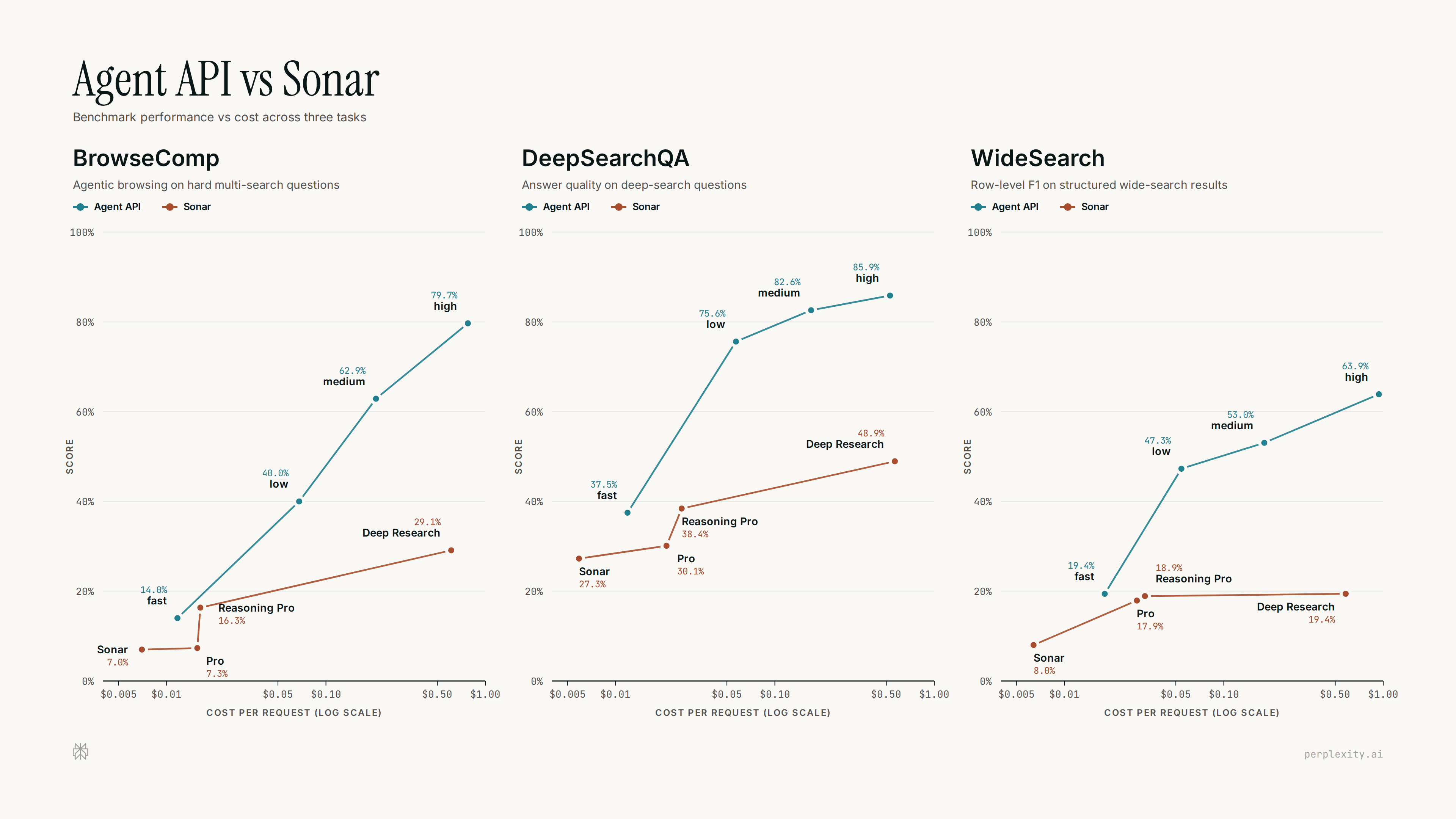
The low preset delivers roughly a 7x improvement on BrowseComp compared to Sonar Pro at approximately $0.05 per query. Agent API presets can match Sonar Deep Research at a fraction of the cost.
Next steps for Sonar users
If users call Sonar today, they’ll need to point their integration at the Agent API before the retirement date. It is a small change: existing model choice maps to a matching preset, and the request and response formats are slightly different.
Most teams complete this in minutes. Our coding-agent skill can apply the change in place, and the migration guide at docs.perplexity.ai walks through the mapping field by field for engineers doing it manually.
If nothing changes by the retirement date, Sonar calls will stop working, so we recommend migrating early in the grace period.
Ongoing availability
Sonar endpoints remain fully available today. On September 27, 2026, the Agent API becomes the main surface for this work, and Sonar tiers retire on the same date. Every existing tier maps to a preset that benchmarks higher at lower cost, so the move consolidates workloads onto one programmable stack without giving anything up. Migration docs, preset details, and the field-by-field mapping guide are at docs.perplexity.ai.