
Deep Research, now in Computer
Deep Research is agentic, iterative search that behaves more like a traditional research analyst. It plans before taking action. It runs multiple searches instead of one, reading the results each time before reasoning what to search for next. It evaluates whether it has enough evidence and notes conflicts, reads deeply, and then synthesizes the results into a single authoritative answer.
The depth is why Deep Research takes longer and can use more compute than standard search.
It’s also why Deep Research has been added to Computer. The answer to a hard question is just the beginning. Deep Research quickly leads to a report, a dashboard, or anything else the work calls for. Computer is where that happens.
Today we’re also announcing that Deep Research can write its own search programs through a new approach called Search as Code. Instead of running one query at a time, Computer builds a custom search plan for each question and runs thousands of steps in parallel. Together, these changes expand what Deep Research can do.
It now pulls from internal files and apps for answers more grounded in business context. Computer turns those answers into work-ready formats like PDFs, decks, dashboards, websites, and more. It also reasons more carefully and integrates into other Computer workflows.
Better inputs, better outputs
Deep Research is the foundation of knowledge work. The quality of a memo, brief, plan, or analysis depends on the quality of the sources and reasoning behind it.
Bringing Deep Research into Computer puts that foundation where the work already happens. A recent study found that nearly 26% of Computer tasks involve research and analysis, the single largest category, ahead of coding, asset creation, and more.
Before today, Computer and Deep Research were separate. Users had to run their Deep Research query in one thread, then open another in Computer to produce a deliverable.
Now users can ask a complex query and Computer will break it down into subtasks routed across 20+ frontier models. Users can get researched answers, ask follow-ups, pull in connected context, and turn findings into finished assets, all in a single query.
When the search warrants it, Computer automatically pulls from premium sources like Statista, PitchBook, and CB Insights, backing answers with authoritative data.
One skill, many paths
In Computer, Deep Research is the entry point to a universal search skill. A single query routes to the right retrieval pattern. Then, it reconciles the results into a unified answer.
Take a question like “Are the non-competes of the employees from the Texas startup we just acquired still enforceable now that we're a California company?”
Computer runs four paths in parallel. It examines California's near-total ban on non-competes and how its courts treat out-of-state agreements. It analyzes Texas enforceability standards, where non-competes are valid if tied to specialized training or trade secrets. It reviews post-acquisition contract assignment case law and the FTC's recent rulemaking on non-competes.
The final output reconciles all four paths into a single risk assessment, sharing which agreements are likely void, which may survive, and where outside counsel is warranted.
A new architecture for AI search
Deep Research in Computer is built on an architecture we call Search as Code.
AI systems usually treat search as a single step: ask a question, find results. Computer treats search as a program. The model writes code that designs and runs thousands of retrieval steps in parallel, each one shaped to the question the user has asked.
The code runs in a secure sandbox right next to the model, so the model can see the results as they arrive and track which sources were pulled and how they scored. It can change course mid-search if the quality isn’t there yet.
In practice, that means a single Deep Research run can:
Break down a question into hundreds or thousands of targeted retrievals
Run searches in parallel, follow new threads when they appear, and try again when answers fall short
Clean up results before the model sees them by deduping, joining, and filtering in code
Pull from the live web and and internal sources using authorized Connectors in the same search
The same architecture that can power an audit of 200 software vulnerabilities across vendor security notices can analyze the non-compete agreement landscape across four different jurisdictions.
High quality, cited data
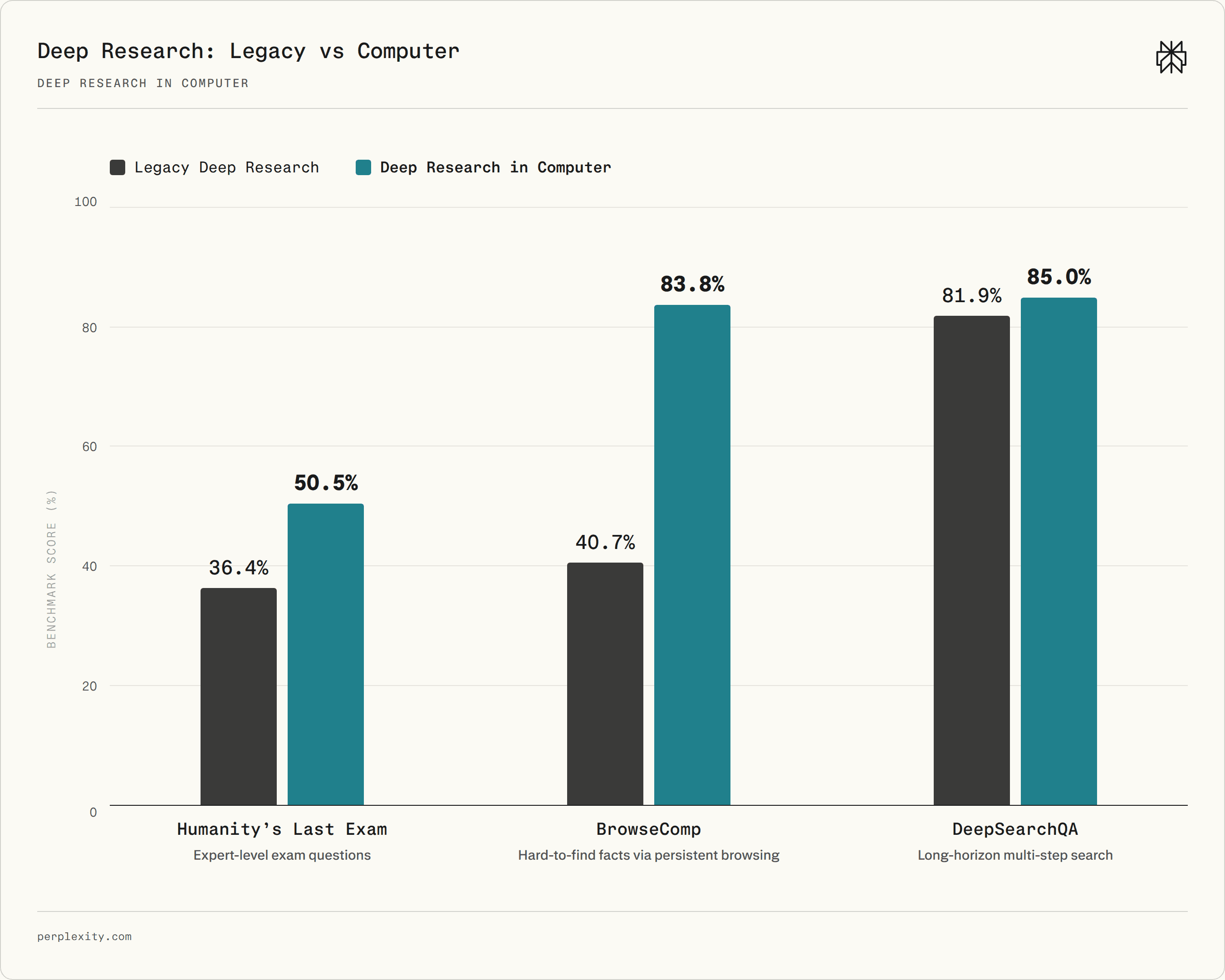
Three AI evaluation benchmarks found that moving Perplexity’s Deep Research inside Computer improves its performance. After the move, factual accuracy, depth of analysis, and citation quality all increased, according to Humanity's Last Exam, BrowseComp, and DeepSearchQA.
Every factual claim in Deep Research carries an inline citation. Each numbered superscript links directly to a live source URL, so users can click through and verify the source.
Example queries
Here’s what Deep Research can do inside Computer:
Buy-side due diligence (Finance): Conduct buy‑side due diligence on three publicly listed European grocery retailers. Compile their financial performance, store formats, private‑label penetration, supply‑chain resilience, labor cost exposure, and recent restructuring actions into a structured table, plus a short memo highlighting major risks and upside scenarios.
Pipeline competitive review (Healthcare): Assess a competitor's experimental CAR-T therapy in relapsed/refractory multiple myeloma to sharpen internal program strategy. Synthesize Phase 1/2 trial readouts, toxicity and response data, comparative outcomes against approved alternatives, payer coverage trends, and active trial sites. Connect via App Connectors to internal preclinical data, prior protocol designs, and regulatory filings, then produce a structured briefing for the development committee with positioning recommendations and open scientific questions.
View more sample Deep Research queries in our use case library.
Now available
Deep Research in Computer is available today. Start a thread with a complex question and continue working from the result.
Try Deep Research in Computer.