

Use Cases
Compare different stocks
Categories
Overview
Individual investors, portfolio managers, and financial advisors need quick, comprehensive comparisons of stocks within the same sector to make informed investment decisions. Rather than toggling between multiple financial websites and manually compiling data, Perplexity can instantly aggregate real-time stock data, financial metrics, analyst ratings, and recent news into side-by-side comparisons that highlight key differences and relative performance.
Your search
Compare NVIDIA, AMD, and Broadcom stocks.
Perplexity's answer
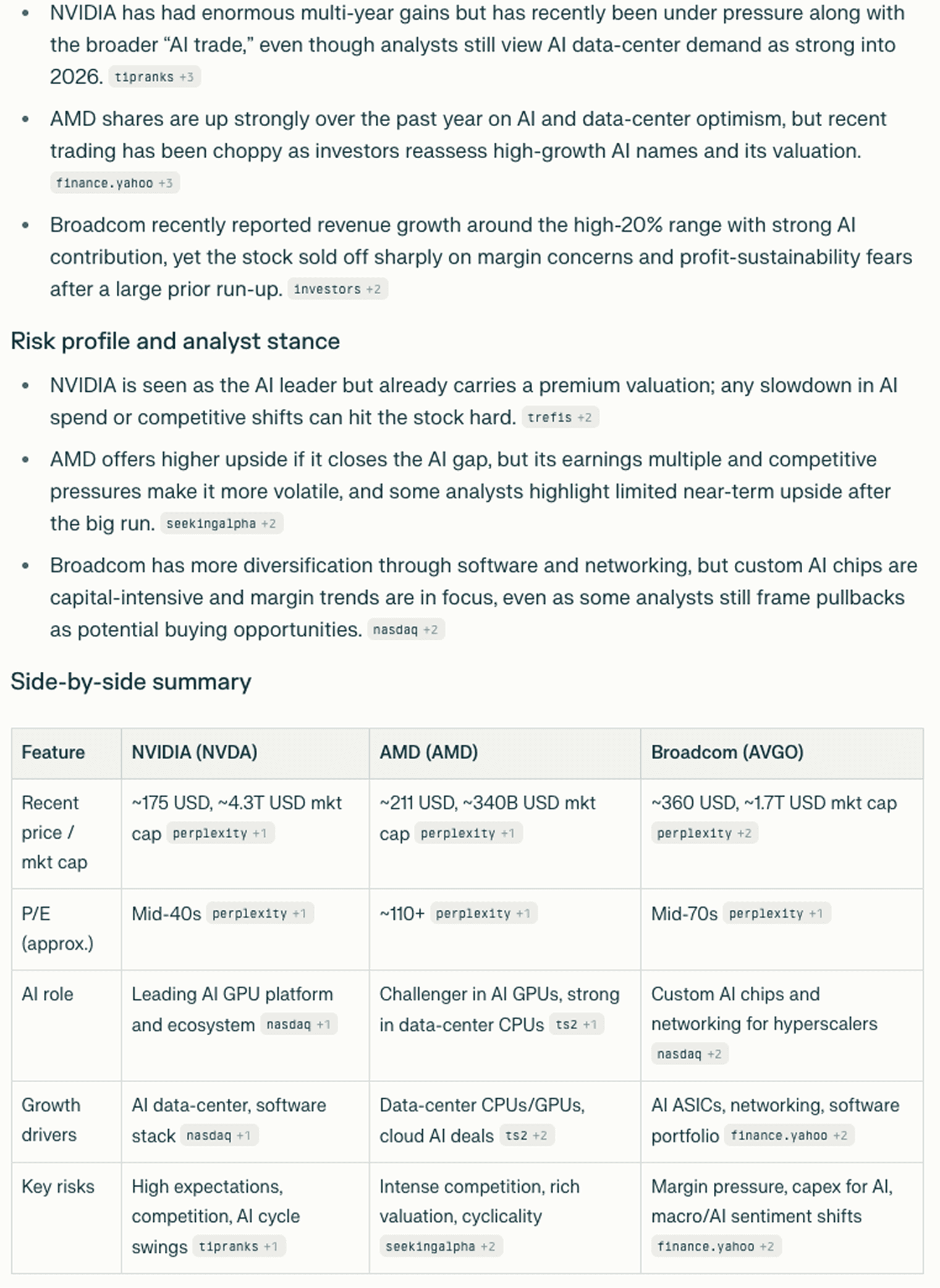
Perplexity generates a comprehensive multi-dimensional comparison including:
Real-time stock performance: Current price, daily change, YTD performance, 52-week range displayed in live interactive charts
Valuation metrics: P/E ratio, forward P/E, PEG ratio, price-to-sales, market capitalization
Financial performance: Revenue growth, profit margins, earnings per share, revenue trends
Analyst sentiment: Consensus ratings (buy/hold/sell), price targets, recent upgrades/downgrades
Recent catalysts: Earnings announcements, product launches, major partnerships, and news events affecting each stock
Technical indicators: Relative strength, momentum indicators, support/resistance levels
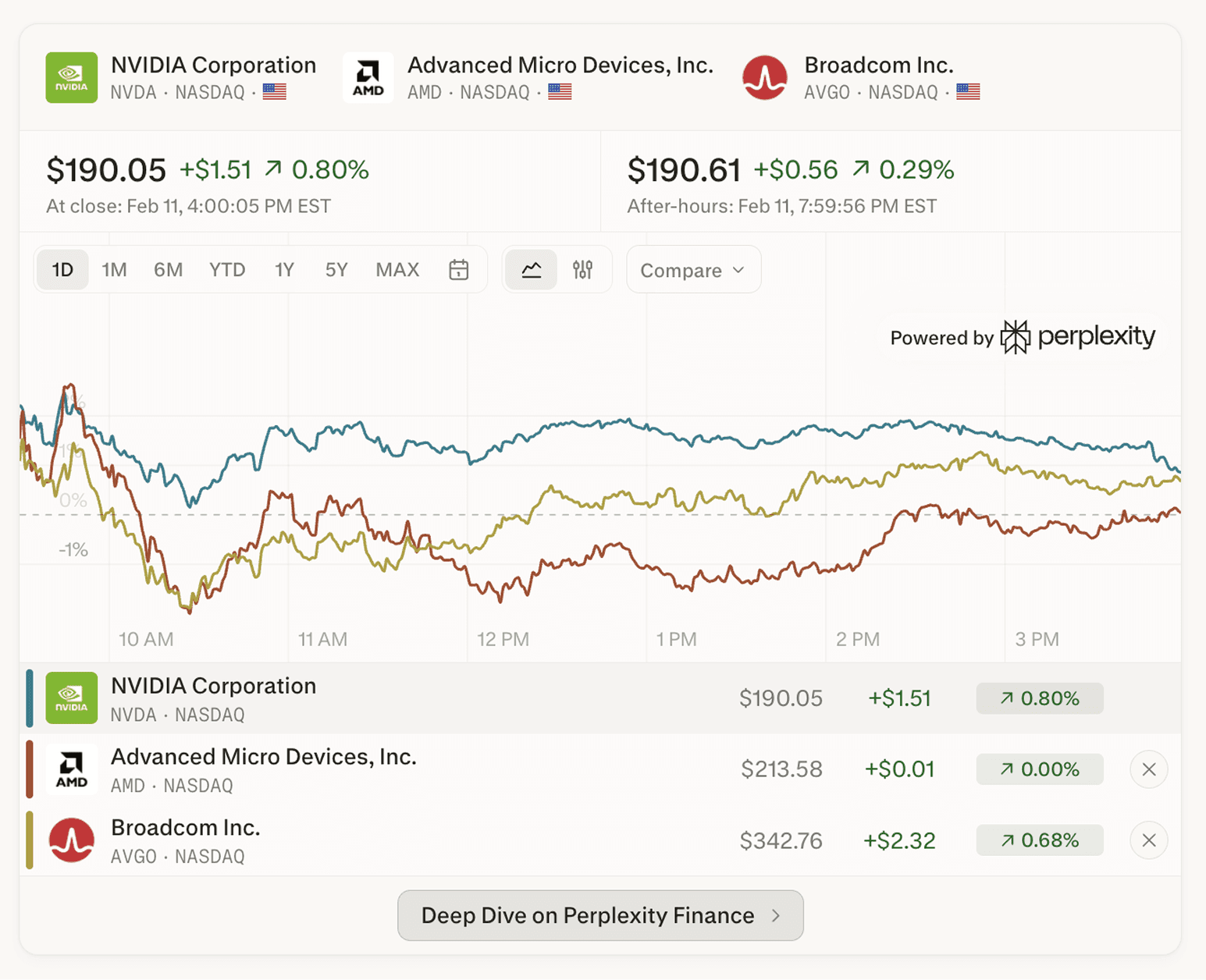
The comparison is presented as an interactive dashboard with side-by-side tables and performance charts. You can export this as a PDF investment brief, save the raw data as a CSV for your own analysis, or share an interactive link with your investment committee. Before finalizing, you can refine the analysis by asking follow-ups like "Which has the strongest balance sheet?" or "Show me 5-year revenue growth trends for all three."
Tips
Add timeframe context: "Compare performance over the last 6 months" or "since the beginning of 2025"
Request specific metrics: "Focus on free cash flow generation and return on invested capital"
Ask about fundamentals: "Which company has the best profit margins and why?"
Get forward-looking insights: "What are analysts saying about growth prospects for each?"
Understand risk factors: "What are the biggest risks unique to each company?"
Add more competitors: "Add Intel and Qualcomm to this comparison"
Request sector context: "How do these compare to the semiconductor sector average?"